How do you stop scope creep on a fixed-price project?
Write down what is in scope, what is out of scope, and how a change gets priced before work starts. Then every new request is a change request with a cost, not a quiet extra.
What are the four things to write down?
- Name the business problem in one or two sentences, in your words.
- List what the project will deliver, one line per item.
- List what it will not deliver. Be as specific as the first list.
- Describe how a change is requested, priced and approved.
Keep all four on one page. Both sides sign or confirm it by email before build work begins.
What is scope creep?
Scope creep is work added to a project after it starts, without an agreed change to price or time. Project management sources describe it as the gap between approved scope and what is actually being built.
On a fixed-price project the effect is plain. The price stays the same while the work grows, so someone absorbs the difference. That is where most price arguments begin.
Why does the problem statement come first?
A consultant who builds before the problem is clear will build the wrong thing, then change it. Each change looks small, and together they use the budget.
A one-line problem statement gives both sides a test for every request: does this help solve the stated problem? If not, it is a change.
Problem: the sales team cannot see which quotes are waiting for a manager.
Deliver: a quote list, an approval button, a daily reminder email.
Not included: a customer portal, a phone app, links to the invoicing system.
How should you write the out-of-scope list?
- Name each feature you discussed and chose to leave out.
- Name each system you will not connect to.
- State how many rounds of review the price covers.
- State who the consultant trains, and how many sessions the price covers.
- State that anything not listed as delivered is a change.
How does a change request work?
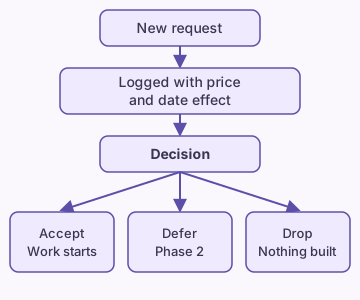
A change request has five fields: the date, what is asked, the effect on price, the effect on the end date, and the decision. Keep them in one log, not spread across email threads.
See change request log for a simple way to track them. The point is that nothing is built from a hallway request.
Tip: Answer every change request within two working days, even if the answer is a price still to come.
Fixed price or time and materials: which fits?
| Question | Fixed price | Time and materials |
|---|---|---|
| Is the scope clear and small? | Fits well | Works, with less cost certainty |
| Will requirements change often? | Many change requests | Fits well |
| Who carries the cost of surprises? | The consultant, until a change is agreed | You |
| Do you need a firm budget? | Yes | Set a cap and review weekly |
For work with unclear scope, a short paid discovery phase followed by a fixed price build is a common middle path.
What should you do when scope has already crept?
- Stop and list everything built or requested since the start.
- Compare that list with the original deliverables.
- Mark each difference as agreed, not agreed, or dropped.
- Price the agreed ones and send the total to the decision maker.
- Reset the end date and update the written scope.
What if a tool is the wrong fit?
Sometimes a request grows because the tool chosen cannot do the job. A good consultant says so early and offers another route, such as a simpler tool or a smaller first phase.
Ask this at the start: what would make this the wrong tool, and how will we know? See RACI chart in Microsoft 365 for who decides when the answer is yes.
Want help with this?
250 High Street is an independent consultancy run by Al Davies. We write scope, out-of-scope and change rules into every fixed-price project. Read about us or see our guide on approval workflows at a fixed price.
FAQ
Is scope creep always the client's fault?
No. It also comes from unclear scope, or from a consultant who adds extras without asking. A written scope protects both sides.
Can I say no to a change request?
Yes. A change request is a question with a price. You can accept, defer or drop it.
How detailed should the out-of-scope list be?
As detailed as the in-scope list. Each feature you talked about and chose to leave out should appear.
What if the consultant forgot something that was in scope?
Then it is part of the price. The written deliverables list decides, which is why it must be specific.